
We all know it.
It’s a fact we all live with.
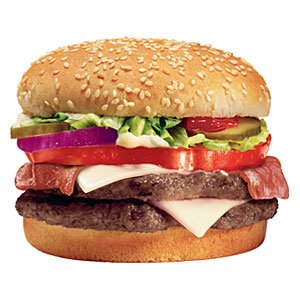
The food that we see on all of the fast food advertisements never look like what’s lurking inside that cardboard box.
The following images present them side-by-side, thus showing the contrast between advertising and reality.
Let’s make sure our Church websites and media doesn’t do the same thing.
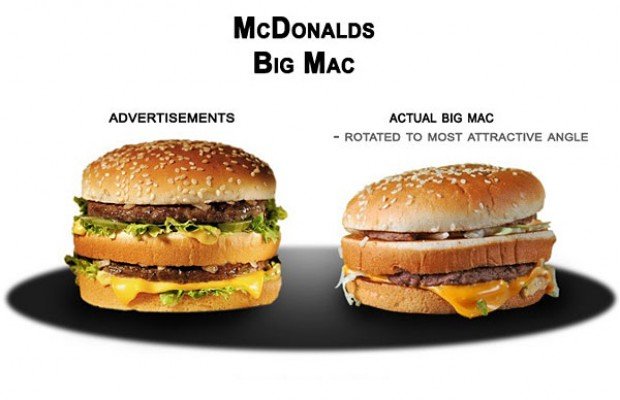

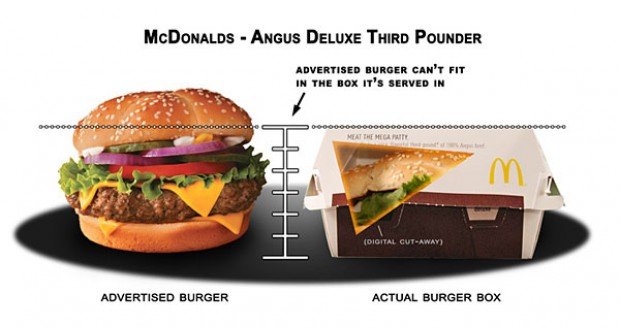
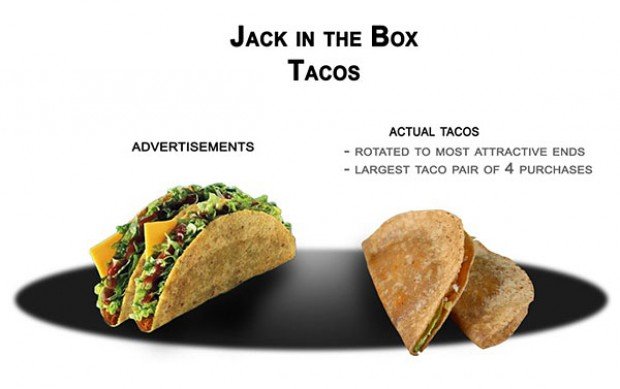

There’s a fine-line between putting your best foot forward, and bearing false witness.
[via Bored Panda]

Eric Dye
Support Lead at Valet, and Proprietor of DYECASTING. Human by day, gamer at night, lover of coffee, and all things spicy.







I love this.
😀
This is awesome. So very true (although, to be fair, I have had Taco Bell tacos that were stuffed to the point of these in the photo).
Reminds me of those expose ads run showing supermodels without the makeup and Photoshop.
I very much had this problem with the first website I designed for our little church plant. The image did not fit the reality. The reality wasn’t bad, it just was a very different feel from the site. Lesson learned.
Awesome.
Yum
I know, right?
Great, now I want some Taco Bell.
I’m getting hungry all over again just leaving this comment.
I think the same could be said broadly about our own individual sites & media…
I’m also suddenly craving burgers and/or tacos…
Maybe we need more burgers and tacos on our individual sites?
Interesting.
Having made many of the ads for McDonald’s I have learnt another side to the story. Customers don’t just go in there for food in the functional sense.
They go in there because the brand provides them with an intangible value even though, yes, the food looks different from the advertising.
Consumers go into restaurants like McDonald’s with a similar mindset to walking into a movie. We know what we see is hyper real, and does not represent real life. But we for a moment willingly give over our imagination to it as though it were, because we get something from it.
The cynic would call it escapism.
But I think there is a lot to be said about intangible value. It would be foolish to ignore that that is how the mind works – on symbols, ideal scenarios, associations.
My Sony TV is made by the same factory as the unknown brand. But I pay more for satisfaction, even if it is imagined. My car doesn’t need a sports kit, because I’m not a racing car driver. But I like it because something in me tingles when I drive it.
It doesn’t just apply to materialist possessions.
My apartment isn’t very spacious, it is not very grand. But it somehow feels like home. I might just be imagining it, but it has value nonetheless.
I once put a godly “faith” theme into one of my ads. It had nothing to do with telephones, but it gave the viewer an intangible value – a feeling that maybe it would be nice to feel like they could be protected by something greater than themselves.
Some interesting points, Justin. I’ve also done a lot of advertising in my career, so I can relate to some of your points.
I think what this article is about is cognitive dissonance. It’s the distance between that ideal presented on the left and the reality we actually receive or experience.
What I hear you saying is that people sort of suspend disbelief, or dissatisfaction thanks to the power of the brand (c.f. Reality Distortion Field). That ring a bell?
I’d posit that when the gap between the presented ideal (say, perfect, shiny, happy people on church website) and reality (poor, boorish, unfriendly people when you visit) grows beyond a certain amount, that feeling of cognitive dissonance kicks in – it doesn’t fit. I think this is true of products, as well; to take your example of your Sony TV: if you bought it and it was all beat up, or didn’t work properly, you’d feel that twinge.
Exactly, Allan.
It’s been said that image is everything. Now putting aside the literal fact that this is so, but it’s interesting that the devil must have come across as the greatest advertiser in history to Adam and Eve when he went about spruiking the so-called benefits of the forbidden fruit. His selling of it subtly appealed to their senses just like modern advertisers and religious corporations accentuate style over substance ie being clothed in the best suits, schooled at the top institutions, holidaying in the most prestigious locations, living in the finest suburbs, etc. all for what? Just so you can fork over your hard earned money to them? Yes! But they want even more! Your loyalty to them and their brand be it an item of clothing, a restaurant franchise or a form of religion. It’s the same in politics as well and demonstrates why voters always vote Democrat or Republican in spite of their hollow promises. They know our emotions can be manipulated and swayed by their idealistic commercials and vague sermons about hope and prosperity even though the reality always falls far short of the fantastic image.
🙂